Frameworks · Relational Efficacy™
How does individual capability
become organisational capability?
Schools are filled with capable people. Teachers who care deeply about their students. Leaders committed to improvement. Teams with expertise, experience and good intentions.
And yet organisations made up of equally capable people often achieve remarkably different outcomes.
Perhaps capability alone is not enough.
Capability develops between people.
Why This Question Exists
Much of educational improvement focuses on developing individuals. We invest in professional learning. Leadership development. Coaching. Collaboration. Feedback. These investments matter.
Yet organisations do not improve simply because capable people work within them. Some schools consistently strengthen collective capability. Others remain dependent on the efforts of individual leaders or exceptional teachers.
The difference may not lie in capability itself.
It may lie in what happens between people.
The Missing Explanation
Relationships have long been recognised as important within organisations. They strengthen trust. Support collaboration. Create psychological safety. Encourage professional learning. All of these matter.
Relational Efficacy begins from a different proposition. Relationships do not simply support improvement.
They shape belief.
Every leadership conversation, every coaching interaction, every moment of encouragement quietly influences what people believe they are capable of becoming. Capability therefore develops relationally. Not simply individually.
Introducing Relational Efficacy™
Relational Efficacy is a conceptual framework for understanding how belief becomes organisational capability.
It is not a framework about relationships alone. Nor is it another model of collaboration. Instead, it proposes that organisational capability emerges because belief is continually strengthened through everyday relational interactions.
Rather than asking only whether people possess capability, Relational Efficacy asks a different question:
How are relationships shaping what people believe is possible?
The Relational Mechanism
Expressed
Leadership expresses belief — through everyday conversations, encouragement and trust.
Reinforced
Colleagues reinforce belief — through shared problem-solving and constructive challenge.
Activated
Professional practice activates belief — confidence becomes contribution.
These interactions are rarely dramatic. Yet each has the potential to strengthen—or weaken—the confidence people have in themselves, in one another and in the work they are trying to accomplish. Over time, these countless relational moments shape not only individual confidence but collective organisational capability.
Relational Efficacy is the name given to that organisational process.
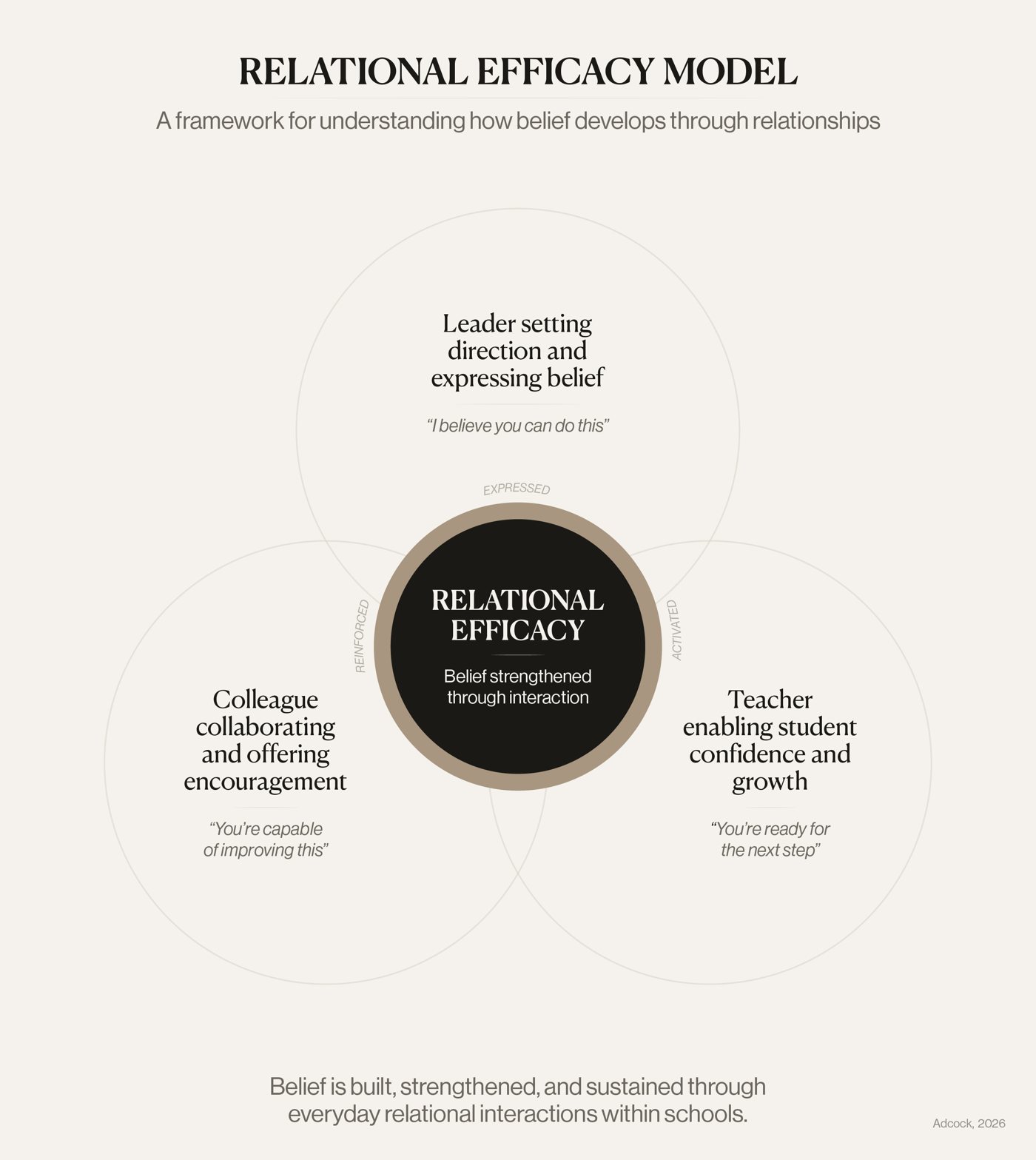
The Relational Efficacy Model — belief is built, strengthened and sustained through relationships.
Individual capability does not become organisational capability by accident.
It becomes organisational capability because belief is continually expressed, reinforced and activated through relationships.
Looking Through This Lens
Viewed through this lens, organisations begin to look different. Leaders become curious about more than professional capability. They begin noticing the relational conditions that shape it: where belief is expressed, reinforced and activated, and which everyday interactions strengthen confidence or quietly diminish it.
Capability is no longer understood simply as an individual attribute. It becomes something organisations continually create through the quality of everyday relationships.
Research in Conversation
Relational Efficacy sits alongside important conversations in collective efficacy, organisational behaviour, social learning, educational leadership and improvement science. These fields have contributed significantly to understanding how people and organisations improve.
Relational Efficacy does not seek to replace these perspectives. Instead, it offers a different organising idea: that organisational capability emerges because belief is continually shaped through relationships.
It is an evolving conceptual synthesis developed through leadership practice, sustained inquiry and engagement with research.
Questions This Framework Invites
If organisational capability develops through relationships…
How is belief being expressed across your organisation?
Who reinforces it?
Where is it activated?
Which everyday interactions strengthen people's confidence?
Which unintentionally weaken it?
And perhaps the most important question:
If relationships shape belief… what kind of organisation are your relationships creating?
Continue Exploring
If Relational Efficacy explains how organisations develop collective capability, the next question naturally follows.
What happens to that capability as improvement moves through an organisation?
The Impact Gap explores why intended improvement often changes between vision and everyday practice, and how organisations can begin to understand that journey.