Frameworks · Theory of Improvement Cultures™
What organisational architecture
allows improvement cultures
to emerge and endure?
Every organisation has a culture. It can be seen in the conversations people have, the decisions they make, the way challenges are approached, the assumptions they hold about what is possible.
Culture is everywhere. Yet one question remains surprisingly difficult to answer.
Where does culture actually come from?
The architecture beneath culture.
Why This Question Exists
Educational improvement has become increasingly sophisticated. Schools invest in leadership development. Professional learning. Strategic planning. Implementation science. Collaborative inquiry. Evidence-informed practice.
Yet organisations investing in remarkably similar strategies often experience remarkably different outcomes. Some develop momentum; others experience fatigue. Some create deep collective ownership; others rely upon continual leadership pressure. Some sustain improvement over many years; others continually restart the same initiatives.
The explanation rarely lies within any one strategy. Nor within any single leader.
Perhaps sustainable improvement is not produced by individual initiatives at all. Perhaps it emerges from something deeper.
The Missing Explanation
Throughout the preceding frameworks, a pattern has gradually emerged. Relationships shape belief. Belief develops into efficacy. Shared belief strengthens shared direction. Direction creates organisational coherence. Coherent organisations preserve improvement as it moves through everyday practice.
None of these conditions exist independently. Each continually shapes the others. Together they form an organisational architecture — often invisible while it is developing, yet unmistakable once it has become culture.
Perhaps culture is not another organisational variable. Perhaps culture is simply what this architecture looks like when it is experienced every day.
Organisations rarely become what they aspire to be. They become what their everyday conditions continually make possible.
Introducing the Theory of Improvement Cultures™
The Theory of Improvement Cultures is a conceptual framework for understanding the relational architecture of sustained school improvement.
It is not another model of organisational culture. Nor is it a sequence for implementing change. Instead, it proposes that sustainable improvement emerges when multiple organisational conditions continually reinforce one another.
The framework invites leaders to shift their attention. Away from trying to create culture directly.
Towards understanding the architecture that continually produces it.
The Relational Architecture
At the heart of this architecture sits Relational Efficacy. Not simply because relationships matter. But because relationships are where belief begins.
The architecture is therefore not linear. It is relational. Every condition strengthens—or weakens—the conditions around it.
When these interactions become increasingly aligned, organisations experience greater clarity, greater confidence, greater coherence. Improvement no longer depends upon isolated acts of leadership. It becomes woven into the everyday life of the organisation.
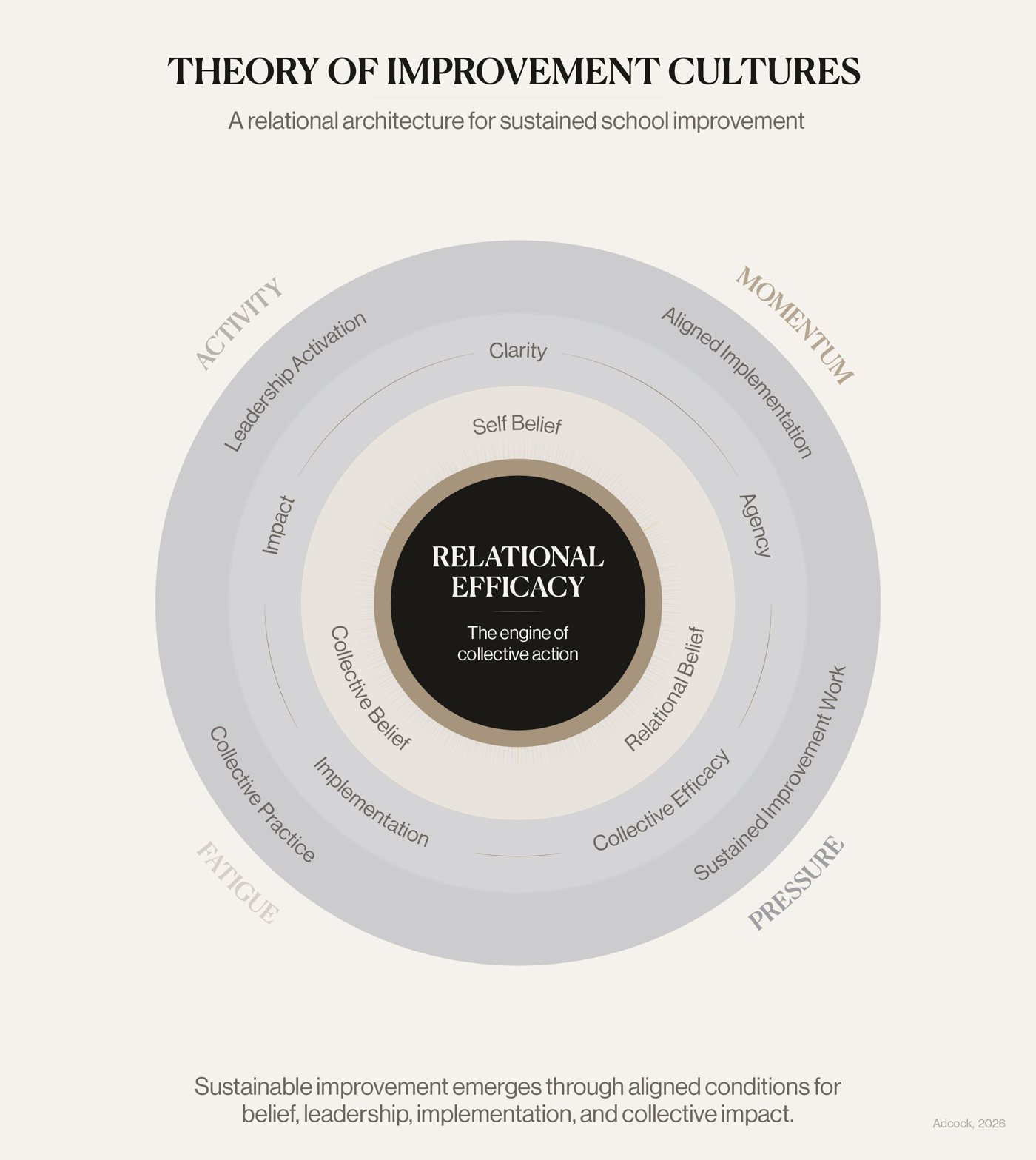
The Theory of Improvement Cultures™ — sustainable improvement emerges through aligned conditions.
The Architecture in Motion
…and that impact, in turn, reshapes belief. The architecture circulates.
Sustainable improvement does not emerge from isolated strategies, initiatives or leaders.
It emerges from an organisational architecture in which relationships, belief, efficacy, direction, implementation and leadership continually reinforce one another over time.
Looking Through This Lens
Viewed through this lens, leaders begin asking different questions. Not: “How do we improve culture?” But: “What conditions are continually producing the culture we experience?”
Culture is no longer understood as something separate from organisational life. It becomes the visible expression of the invisible conditions that shape organisational life every day.
Questions This Framework Invites
If culture is the visible expression of deeper organisational conditions…
What beliefs are your relationships reinforcing?
How is efficacy developing across your organisation?
Where is clarity becoming coherence?
How is implementation preserving — or diminishing — your original intention?
Which conditions are creating momentum, and which are unintentionally creating pressure?
Where is fatigue emerging — not as a problem to solve, but as evidence that part of the architecture is no longer reinforcing the whole?
And perhaps the most important question of all:
If your organisation is continually becoming what its everyday conditions make possible… what are those conditions making possible today?
Research in Conversation
The Theory of Improvement Cultures sits in conversation with research relating to organisational culture, complexity, systems thinking, implementation science, organisational learning, collective efficacy and educational leadership. Each of these traditions has contributed significantly to understanding how organisations improve.
This framework does not seek to replace those perspectives. Instead, it offers a relational synthesis. Its contribution lies in proposing that sustainable improvement is best understood not through isolated concepts, but through the interaction of organisational conditions that together create an enduring improvement culture.
Continue Exploring
Every framework in this body of work has explored one part of a larger proposition.
Relational Efficacy showed where belief begins. The Impact Gap explained what happens to improvement as it travels. The Direction × Belief Culture Map explored organisational coherence. The Belief Cascade revealed how belief develops. Inside-Out Impact traced the pathway through which internal conditions become enduring impact.
The Theory of Improvement Cultures gathers them into one relational architecture — the broader culmination of the six.
Every enduring organisational outcome was once an invisible organisational condition.
The Reading Room explores those invisible conditions through essays, research and reflection for leaders committed not simply to improving organisations, but to understanding how enduring improvement actually emerges.