EIA Applied Architecture
The School Improvement Pathway™
From fragmented improvement efforts to aligned leadership, collective efficacy and sustained impact.
Insight
Diagnosing Improvement Conditions
Direction
Strategic Clarity & Alignment
Belief
Relational Culture & Collective Efficacy
Leadership
Leadership Activation & Practice Alignment
Sustained Impact
System Alignment & Sustainable Impact
Schools rarely lack improvement activity.
They have priorities.
Plans.
Professional learning.
Leadership structures.
Initiatives designed with genuine intent.
Yet activity does not automatically create coherence.
Improvement can become fragmented when strategic direction, organisational belief, leadership practice and the systems surrounding the work are not sufficiently aligned.
The School Improvement Pathway™ provides a way of seeing these conditions together.
It helps educational leaders recognise where improvement may currently be strengthened or constrained, where greater attention may be needed and how the different conditions supporting sustained improvement connect.
Because sustainable improvement is not created through one intervention.
It is built through alignment.
InsightDiagnosing Improvement Conditions
Improvement begins with understanding.
Before deciding what needs to change, leaders need a clearer view of the conditions already shaping organisational experience.
Where is leadership intention translating into impact?
Where is it weakening?
What is creating momentum?
What may be quietly limiting it?
Insight helps leaders move beyond assumption and make the conditions surrounding improvement more visible.
Diagnose what is driving — or limiting — impact.
Impact Gap Diagnostic™
DirectionStrategic Clarity & Alignment
Clarity is more than knowing the priorities.
It is understanding how they connect.
When everything matters, organisational attention becomes fragmented. People may work hard while experiencing competing messages, overlapping initiatives or uncertainty about what should receive greatest attention.
Direction creates coherence. It helps leaders clarify what matters, reduce unnecessary complexity and align organisational energy around a more deliberate improvement agenda.
Clarify direction and reduce initiative overload.
Strategic Alignment Lab™
BeliefRelational Culture & Collective Efficacy
Direction may establish where an organisation is going.
Belief influences whether people move together.
Sustainable improvement depends upon more than individual competence. It requires relational conditions through which people trust one another, experience agency, contribute meaningfully and develop belief in their collective capacity to create impact.
This is where improvement becomes more than something people are asked to implement.
It becomes something they believe they can influence together.
Strengthen belief and collective efficacy.
Relational Efficacy Lab™
LeadershipLeadership Activation & Practice Alignment
Strategy creates little impact if it remains strategy.
Eventually, improvement must become visible in practice.
Leadership plays a critical role in translating organisational direction into the everyday decisions, conversations and practices through which people experience improvement.
This requires more than communicating expectations. It requires leaders across the organisation who can interpret direction, create coherence and support increasingly consistent practice.
Translate strategy into consistent classroom practice.
Middle Leader Impact Program™ · Leadership Development
Sustained ImpactSystem Alignment & Sustainable Impact
The final challenge is not creating change.
It is sustaining it.
Improvement becomes more durable when direction, relationships, leadership practice and organisational systems reinforce one another.
Rather than remaining dependent upon particular individuals or temporary momentum, improvement becomes increasingly embedded within the way the organisation works.
The goal is not simply successful implementation.
It is an organisation increasingly capable of sustaining improvement from within.
Embed systems for sustained whole-school improvement.
Inside-Out Impact Strategic Advisory™
Applied Architecture
A Pathway Through Improvement
The School Improvement Pathway™ brings five connected dimensions of organisational improvement into view.
Each represents a different organisational condition. Together, they provide an architecture for moving from understanding what is happening within an organisation to creating the conditions through which improvement can become increasingly aligned, collective and sustainable.
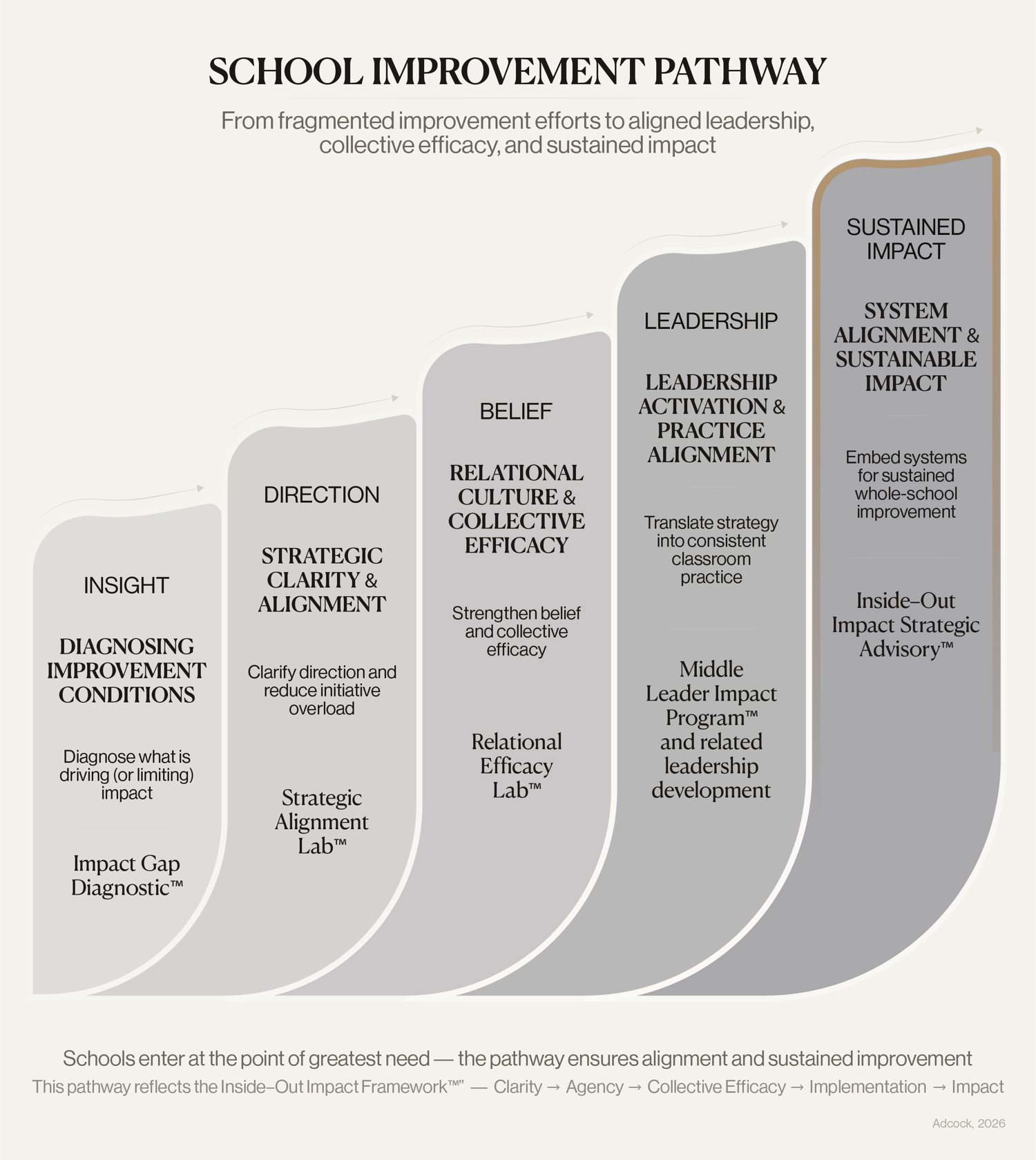
The School Improvement Pathway™ — the applied architecture itself.
Schools Do Not All Begin in the Same Place
The School Improvement Pathway™ has a clear progression.
But that does not mean every organisation needs to begin at the same point.
One school may need greater insight into the conditions limiting impact.
Another may need strategic clarity.
Another may have strong direction but insufficient collective belief.
Another may need to strengthen leadership practice.
Another may need to align systems so that existing improvement can endure.
Schools enter at the point of greatest need.
The Pathway ensures that wherever the work begins, it remains connected to the wider conditions required for sustained improvement.
The question is not: Which step should we complete first?
The better question is:
What does this organisation need to strengthen now — and what will that make possible next?
Improvement From the Inside Out
The School Improvement Pathway™ reflects the deeper organisational logic of the Inside-Out Impact Framework™.
Applied pathway
Reflecting the Inside-Out Impact Framework™
Sustainable improvement does not begin with visible outcomes.
It begins with the conditions that make those outcomes possible.
The School Improvement Pathway™ translates that understanding into an applied architecture for school improvement.
Not another initiative.
Not another programme layered onto existing work.
A way of understanding what the organisation needs in order for improvement to become increasingly coherent, collective and sustainable.
By now, you may recognise your own organisation somewhere within this architecture — and wonder where you would enter.
Begin the Conversation