Frameworks · The Belief Cascade™
How does belief become
something an organisation
comes to share?
Every organisation believes something. About its students. About its people. About what improvement is possible. These beliefs shape countless decisions every day — how challenges are interpreted, how setbacks are explained, how opportunities are embraced. Ultimately, they influence what an organisation becomes capable of achieving.
Yet collective belief rarely appears suddenly.
It develops.
Expressed. Internalised. Shared.
Why This Question Exists
Educational leaders often speak about collective efficacy as though it is something organisations build. Research has demonstrated its significance. Schools aspire to develop it. Leaders seek to strengthen it.
Yet collective efficacy rarely emerges in a single initiative, workshop or strategic plan.
Long before an organisation genuinely believes, “We can do this,” individuals must first begin believing, “I can do this.” And even before that, someone has usually communicated, “I believe you can do this.”
Perhaps collective efficacy is not where organisational improvement begins. Perhaps it is where a much longer developmental journey arrives.
The Missing Explanation
Belief is developmental. It grows through experience. Through encouragement. Through challenge. Through success. Through relationships.
What another person believes about us often shapes what we begin believing about ourselves. Over time, those individual beliefs begin influencing the beliefs held by teams. Eventually, belief becomes something larger than any one individual.
It becomes organisational.
Collective efficacy is therefore not the beginning of the story. It is the culmination of countless relational experiences through which belief has gradually developed.
Introducing the Belief Cascade™
The Belief Cascade is a conceptual framework for understanding the developmental progression of efficacy beliefs.
It does not replace existing theories of self-efficacy or collective efficacy. Instead, it explores how these forms of belief are connected — proposing that collective efficacy develops through a progression. Belief is first expressed through relationships. It becomes internalised as self-belief. It is then shared across the organisation as collective efficacy.
The framework therefore asks a different question. Not simply: “Do people believe?” But:
How is belief developing across the organisation?
The Developmental Progression
Relational Efficacy
“I believe you can do this.”
Belief begins relationally. Someone communicates confidence before another person fully possesses it themselves. Leadership. Coaching. Mentoring. Professional collaboration. Everyday encouragement. These moments provide the relational conditions in which belief begins.
Self-Efficacy
“I can do this.”
Gradually, externally expressed belief becomes internalised. Confidence develops. Capability feels increasingly possible. People begin approaching challenges differently because their beliefs about themselves have changed. Self-efficacy is not merely confidence. It is belief that has become personally owned.
Collective Efficacy
“We can do this.”
As individual beliefs become increasingly shared, organisations begin developing collective confidence. People no longer believe only in themselves. They believe in one another. They believe in the organisation's collective capacity to improve. Collective efficacy emerges not as an isolated phenomenon, but as the outcome of a much longer developmental journey.
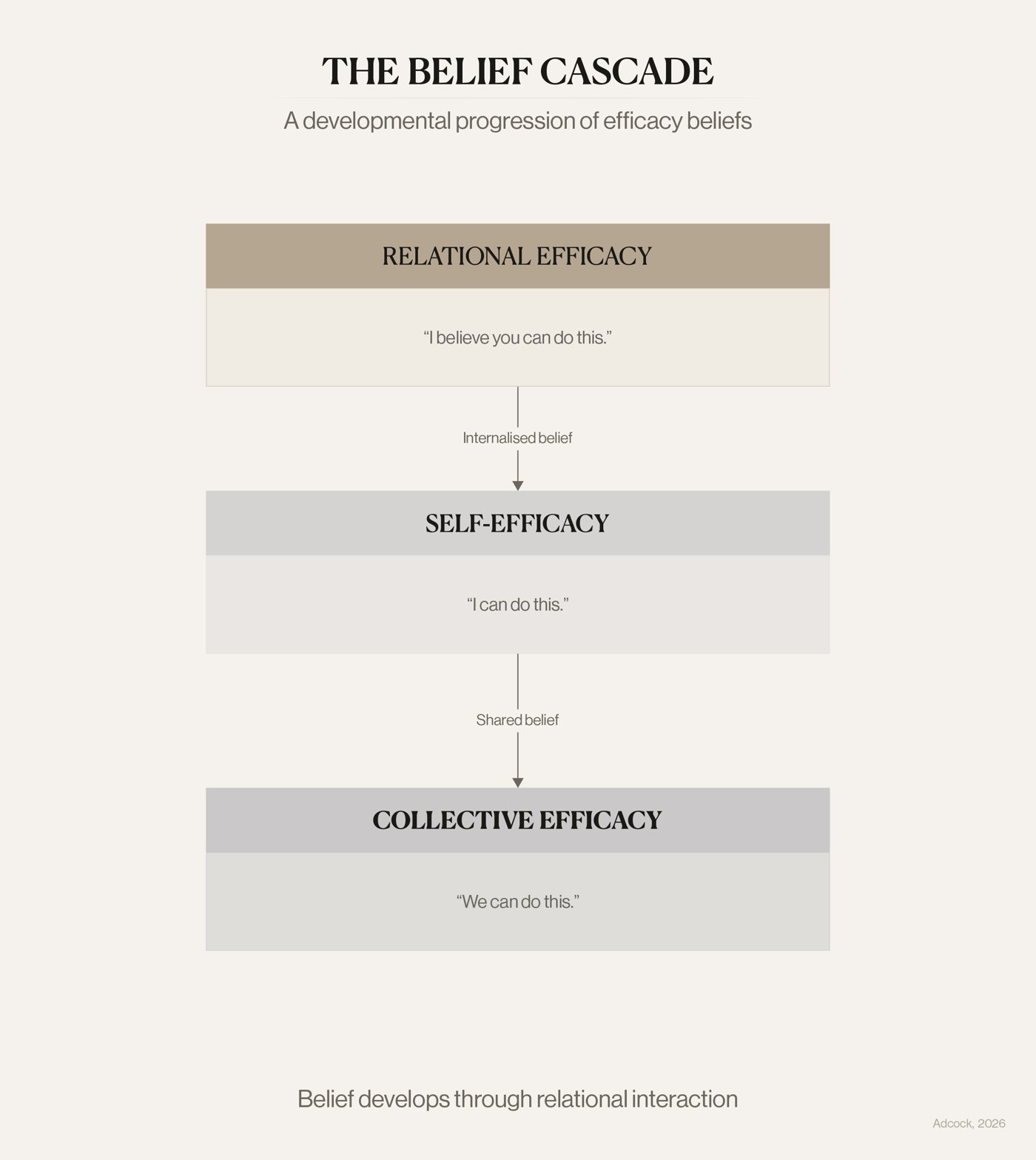
The Belief Cascade™ — read a stage, look across; the model and the words work together.
Collective efficacy is not the beginning of organisational improvement.
It is the outcome of belief that has been continually expressed, internalised and shared through relationships.
Looking Through This Lens
Viewed through this lens, leaders begin asking different questions. Not simply: “How do we build collective efficacy?” But: “Where is belief beginning?”
Leadership shifts from trying to create collective efficacy directly to cultivating the developmental conditions from which it naturally emerges.
Research in Conversation
The Belief Cascade sits alongside important conversations in self-efficacy, collective efficacy, motivation, social learning and educational leadership — fields that have significantly advanced our understanding of how beliefs influence learning, performance and organisational improvement.
It does not seek to replace these perspectives. It offers a conceptual synthesis: that relational efficacy, self-efficacy and collective efficacy can be understood as a developmental progression through which belief evolves from relational experience to individual confidence and ultimately to collective organisational capability.
Questions This Framework Invites
If collective efficacy develops rather than appears…
Who is expressing belief across your organisation?
How is that belief becoming internalised?
Where is confidence beginning to grow?
When does individual confidence become shared confidence?
Which relational experiences strengthen that progression?
Which unintentionally interrupt it?
And perhaps the most important question:
Are you trying to create collective efficacy… or are you intentionally cultivating the developmental journey that allows it to emerge?
Continue Exploring
The Belief Cascade explains how belief develops from relational interaction to collective organisational confidence. The next framework explores what that belief ultimately makes possible — how clarity, agency and collective efficacy develop into consistent implementation and enduring organisational impact.
Because belief is not the destination. It is what makes the destination reachable.