EIA — elevate impact advisory

Frameworks  ·  Direction × Belief Culture Map™

What enables an organisation to remain coherent
as improvement moves through it?


Every organisation has direction. Strategic priorities are identified. Plans are developed. Goals are communicated. Equally, most organisations are filled with people who care deeply about improving outcomes for young people.

And yet these two realities do not automatically produce coherent improvement.

How do direction and belief interact to create organisational coherence?

Where direction meets belief.


Why This Question Exists

Leaders often assume that once priorities are clear, coherence naturally follows. If everyone understands the vision, surely improvement will unfold consistently.

But organisations are not linear systems. Every conversation, every leadership decision, every team meeting, every professional judgement, every interpretation of strategy gradually reshapes what improvement comes to mean.

Coherence is rarely lost in one dramatic moment. It is continually strengthened—or weakened—through everyday organisational life.

Perhaps coherence is not something organisations achieve. Perhaps it is something they continually create.

The Missing Explanation

Direction provides clarity. Belief provides commitment. Neither is sufficient alone.

Direction without belief often produces compliance. People know what they are expected to do. They simply do not own it.

Belief without direction produces energy. People work incredibly hard. But often towards different understandings of improvement.

When shared direction and shared belief continually reinforce one another, something different begins to emerge. The organisation develops coherence. Not because everyone behaves identically.

But because people consistently make decisions that preserve the integrity of the organisation's improvement.


Introducing the
Direction × Belief Culture Map™

The Direction × Belief Culture Map is a conceptual lens for understanding different patterns of organisational improvement.

It is not intended to label schools. Nor to reduce organisational complexity to four categories. Instead, it helps leaders recognise recurring cultural conditions created by the interaction between shared direction and shared belief.

Every organisation moves. Different teams may occupy different places. The same organisation may shift over time.

The map therefore invites interpretation rather than classification.

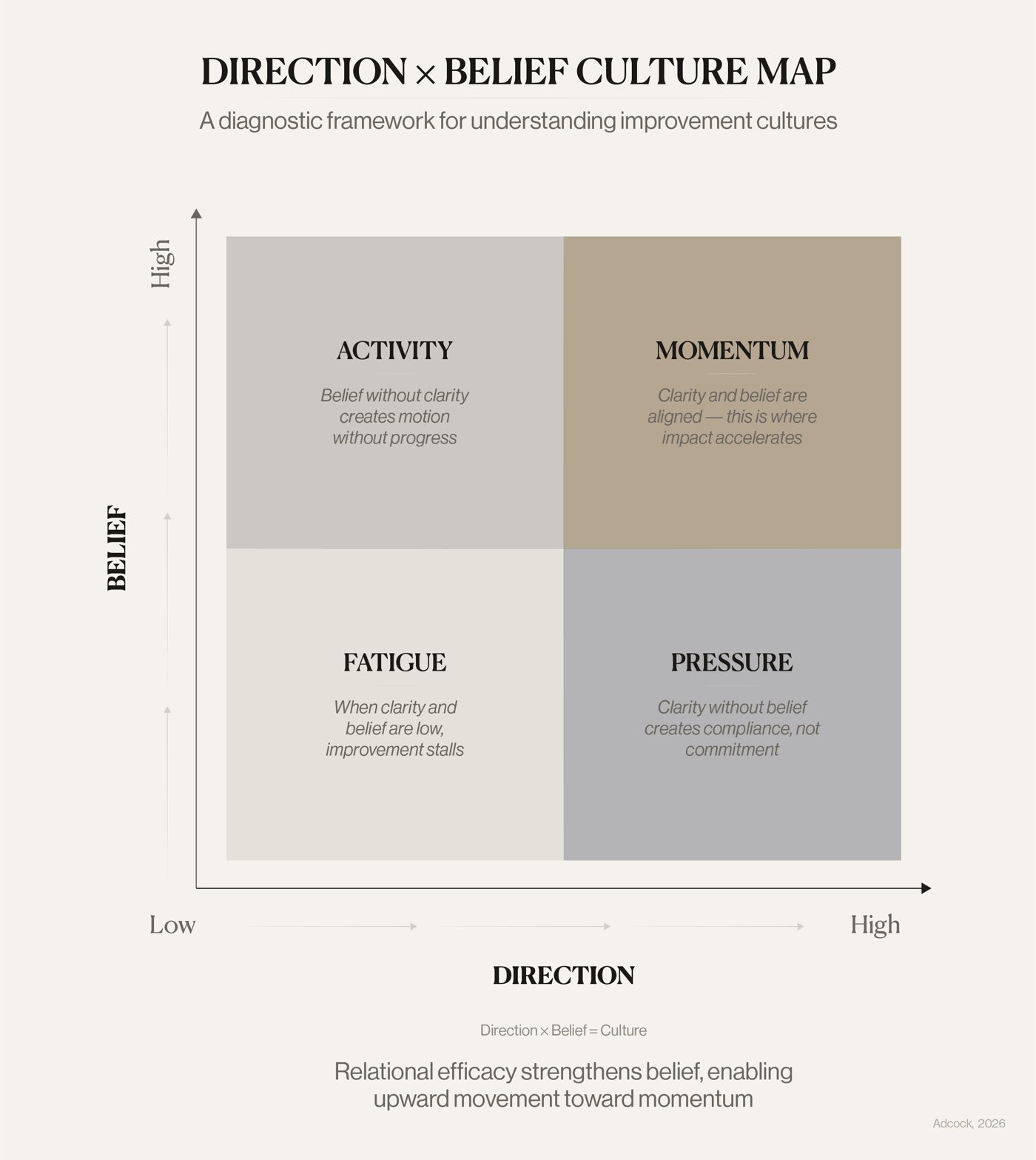
The Direction × Belief Culture Map — four cultural conditions created by the interaction of direction and belief

The Direction × Belief Culture Map™ — relational efficacy strengthens belief, enabling movement toward momentum.

Four Conditions. One Dynamic.

Belief ↑

Activity

Passion Without Coherence

Belief is strong. Direction is less clear. People genuinely care, energy is high, initiative is abundant — yet effort becomes dispersed. There is motion, but not always collective movement. Without shared direction, activity rarely becomes sustained organisational progress.

Momentum

Organisational Coherence

Direction is clear. Belief is strong. People understand where improvement is heading and why it matters. Leadership messages reinforce one another. Improvement gains momentum because coherence allows decisions across the organisation to strengthen rather than compete with one another.

Fatigue

Organisational Drift

Neither direction nor belief provides sufficient stability. Priorities compete. Confidence gradually weakens. The organisation remains busy, yet improvement begins losing coherence — not because people care less, but because neither shared direction nor shared belief is strong enough to hold the work together.

Pressure

Strategic Compliance

Direction is strong. Belief is fragile. People understand the priorities and know what is expected — yet commitment depends heavily on accountability rather than ownership. The organisation may achieve short-term consistency while struggling to sustain long-term commitment.

Direction →

Organisational coherence emerges when shared direction and shared belief continually reinforce one another through everyday organisational life.


A Different Way of Reading the Map

The purpose of the Direction × Belief Culture Map is not to decide which quadrant an organisation occupies.

It is to notice movement.

How does belief change over time? What strengthens direction? Where is coherence growing? Where is it beginning to fragment?

Perhaps the most valuable question is not: “Which quadrant are we in?” But:

“What organisational conditions would move us towards greater coherence?”

Research in Conversation

The Direction × Belief Culture Map sits alongside research relating to strategic leadership, organisational learning, collective efficacy, systems thinking, organisational commitment and educational improvement.

Its contribution is not the individual concepts of direction or belief. Rather, it proposes that organisational coherence emerges through their continual interaction. It is an evolving conceptual synthesis informed by leadership practice, sustained inquiry and engagement with research.

Questions This Framework Invites

If organisational coherence depends on both direction and belief…

Where is direction strongest? Where is belief strongest?

Where do they reinforce one another — and where are they beginning to separate?

Which leadership behaviours strengthen coherence?

Which unintentionally weaken it?

And perhaps the most important question:

Are you trying to improve performance… or are you intentionally cultivating the conditions that allow coherent improvement to emerge?

Continue Exploring

The Direction × Belief Culture Map explains one of the conditions that allows improvement to retain its integrity. The frameworks that follow explore how belief spreads through organisations, how improvement cultures develop, and how leaders intentionally create the organisational conditions in which sustainable improvement becomes possible.

Explore The Belief Cascade™